19.03.2026 | Interviews, Report
The large event hall at the Federal Ministry of the Interior in Berlin: subdued lighting, murmurs of anticipation. Silence falls – the Berlin pub choir begins to sing, in harmony, richly, directly. The guests in the hall: emergency services from fire brigades, aid organisations and technical relief agencies, representatives from politics and associations – people who have been supporting and promoting voluntary civil protection for years.
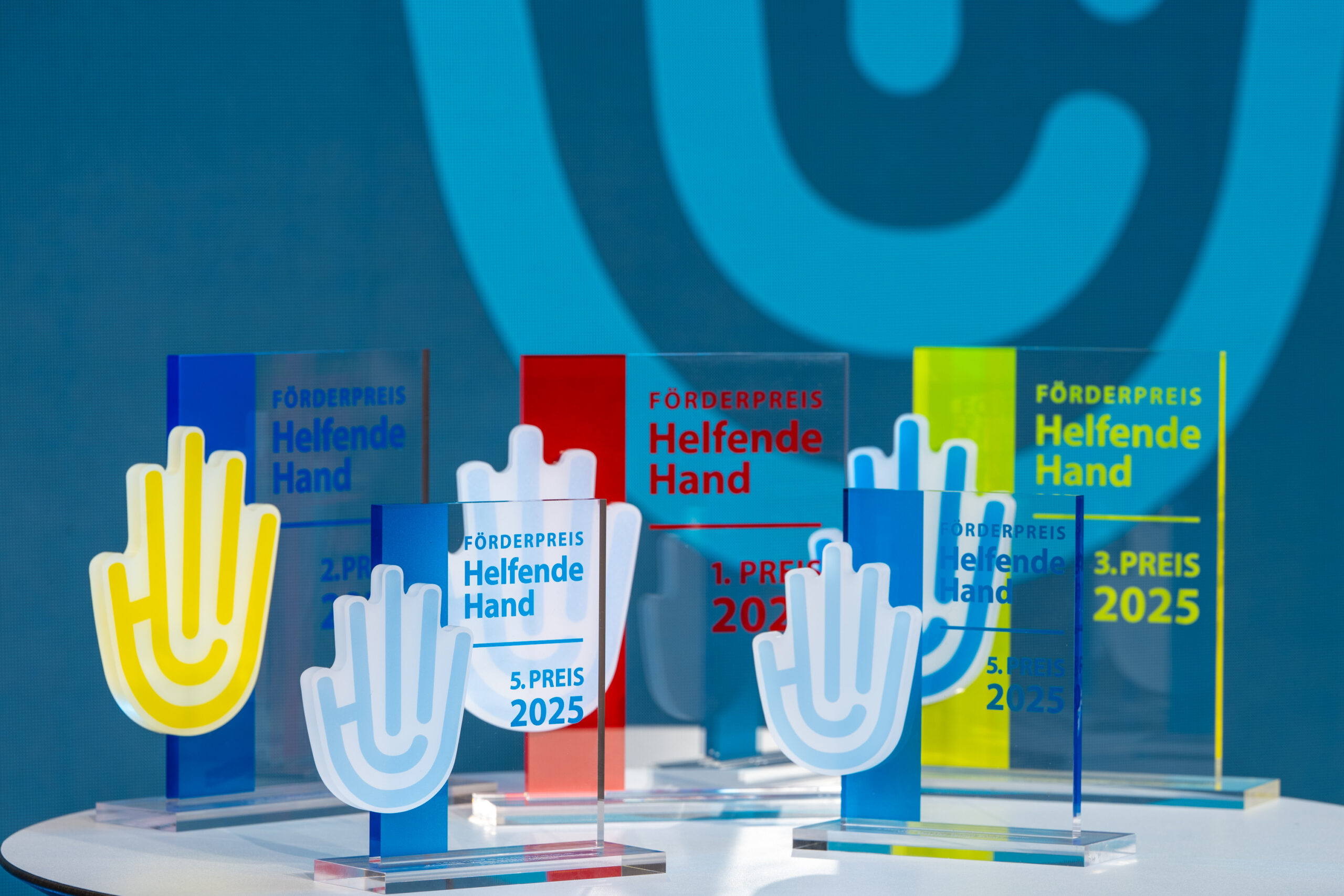
The trophies for the Helping Hand award shine in a new design.
(Source: Björn-Arne Eisermann)
Since 2009, the Federal Ministry of the Interior (BMI) has been awarding the Helping Hand prize, the most important award in Germany for voluntary work in civil protection. This year marks the 17th anniversary of the award ceremony, which traditionally takes place at the beginning of December, around International Volunteer Day. The award is an expression of a twofold solidarity: on the one hand, with the Helping Hand award, the BMI honours the more than 1.7 million volunteers without whom German civil protection would not be able to function. On the other hand, the award ceremony demonstrates how closely the Ministry works with the Federal Office for Civil Protection and Disaster Assistance (BBK). The BBK runs the office for the award, organises the competition year, supports the jury and public relations work, and finally the award ceremony at the BMI.
The importance that the BMI attaches to this commitment is made clear right at the start in the welcoming address: Federal Minister of the Interior Alexander Dobrindt thanks those involved, praises the ‘people who use their knowledge, time and energy to ensure that our country functions in times of crisis’ and emphasises the key role of voluntary work in civil protection. Christoph de Vries, Parliamentary State Secretary at the Federal Ministry of the Interior, then takes over in the hall. He presents the awards as the winners come onto the stage full of anticipation.
The ceremony is hosted by Clarissa Corrêa da Silva. She guides the audience through the programme with ease and warmth, combining the award presentation with short conversations on stage and following the theme of the day: people who are committed in very different ways to modern, inclusive and effective civil protection.
BMI and BBK as joint hosts
In his speech, Christoph de Vries makes it clear what the BMI is aiming to achieve with this award: ‘You show that commitment never stands still, that helpfulness is creative and that great things can be achieved together.’ These are volunteers who train in their spare time, take on responsibility and use their ideas to further develop civil protection. The projects demonstrate how much innovative power, creativity and cohesion can be found in the emergency services.
The figures underline this message: almost 400 applications for the award were received in 2025, from which a jury of experts selected 16 projects for the final round. The award is presented in three main categories: innovative concepts, youth work and support for voluntary work. In addition, there is the special prize for inclusion in voluntary civil protection, which is being awarded for the first time, and the audience award, which the public was able to vote for online.
With this set of categories, the Helping Hand addresses key issues for the future of civil protection:
- How can structures and services be developed in such a way that they fit in with people’s everyday lives?
- How can we attract people to volunteer and retain committed volunteers in the long term?
- How can employers, universities and other partners be made even more accountable?
- And how can civil protection become more inclusive – so that everyone can learn and help?
Many of the award-winning projects can be transferred or adapted to other organisations and locations. Ideas that prove successful in one district can work similarly elsewhere. The fact that the award attracts so many applications, especially in times of crisis, is also a signal to those involved in practical operations: volunteers are responding alertly and creatively to new risks, changing lifestyles and growing expectations.
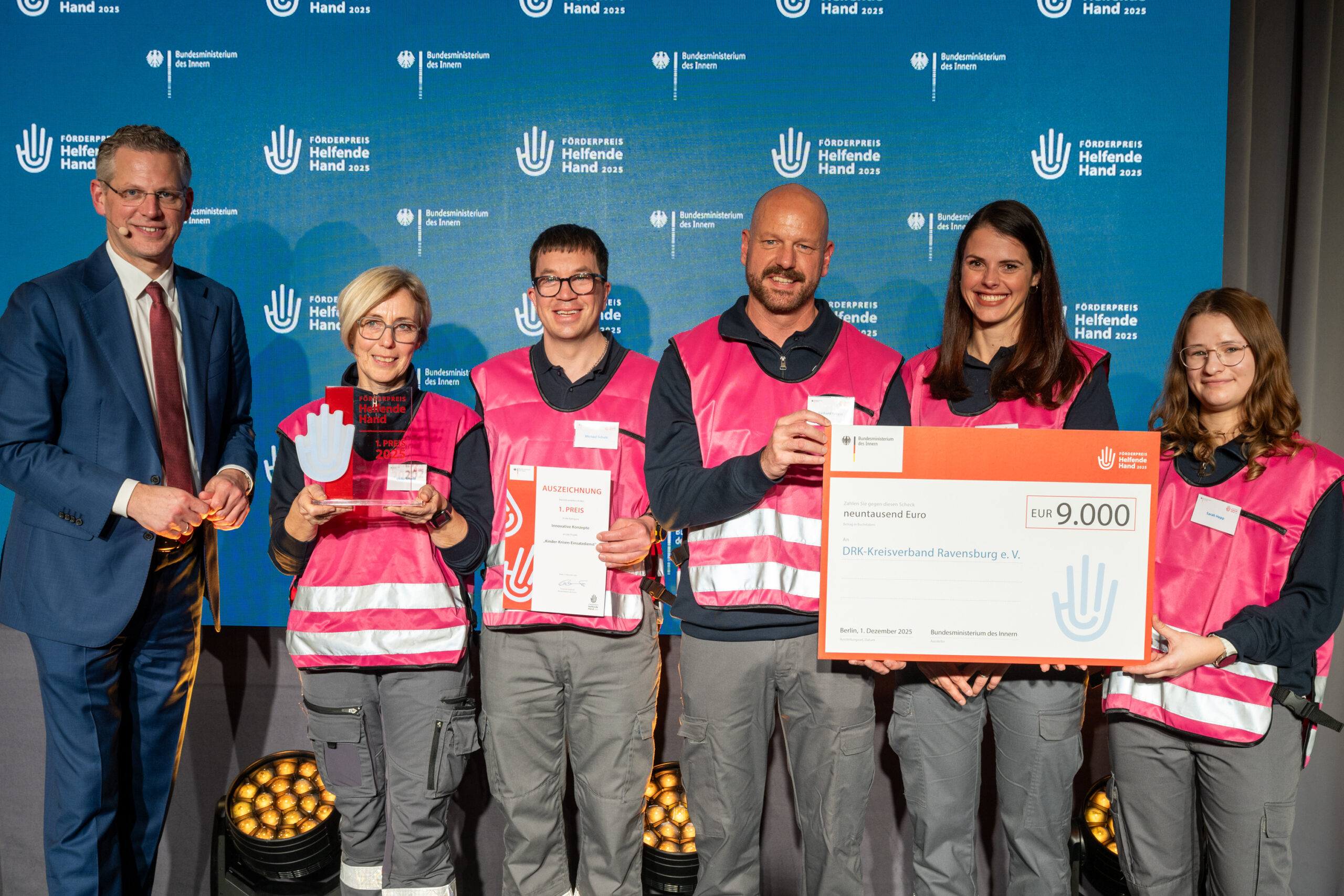
1st place in the Innovative Concepts category: Children’s Crisis Response Service. (Source: Björn-Arne Eisermann)
Innovative concepts
The first block of the afternoon is devoted to the category ‘Innovative Concepts’. Project films are shown on screen, presenting short stories that illustrate what the projects achieve: robotic vehicles on water, digital formats for mission preparation, new training concepts. The jury has nominated five projects – and awards first prize to a team that closes a gap that is noticeable in many operations: the children’s crisis response service of the Ravensburg district association of the German Red Cross.
When there is a fire, when people are seriously injured or killed, children and young people are often just as affected as adults. However, there are currently few specialised services available for them after the event. This is exactly where the volunteer children’s crisis team comes in: specially trained helpers provide emotional first aid for children, accompany them on site, explain what has happened in a child-friendly manner and actively involve caregivers. They stabilise the acute situation, offer follow-up care and, if necessary, arrange further help.
The concept arose from specific experiences in the field – from school bus accidents and fires to sudden deaths in the family environment. It became clear that existing psychosocial emergency care structures are often geared towards adults, with children and young people easily falling by the wayside. The project from Ravensburg draws practical conclusions from this insight: a separate service tailored to children, which is closely networked with schools, youth welfare offices, emergency services and trauma clinics.
For the jury, this is more than just a regional solution. The Children’s Crisis Response Service combines professional training, low-threshold response structures and a clear goal: children in crisis should not only be ‘cared for’ but also specifically empowered. At the same time, the project shows how science, practical application and voluntary work can interact – the Ravensburg-Weingarten University of Applied Sciences and the Centre for Psychiatry, among others, were involved in its development.
In addition to the winner, other projects in this category also demonstrate the broad spectrum of innovations in civil protection: These include ‘Robots as Rescuers and Helpers’ by the DRK Water Rescue Service in Halle (Saale), the ‘Are You Ready for an Emergency?’ format by the fire departments of the city of Hattersheim am Main, ‘Reflexive Emergency Training’ by the ASB Regional Association in Bremen, and ‘OSI – The Live Online Event’ by THW Hamburg. It ranges from technical support and specific training methods to new digital learning formats.
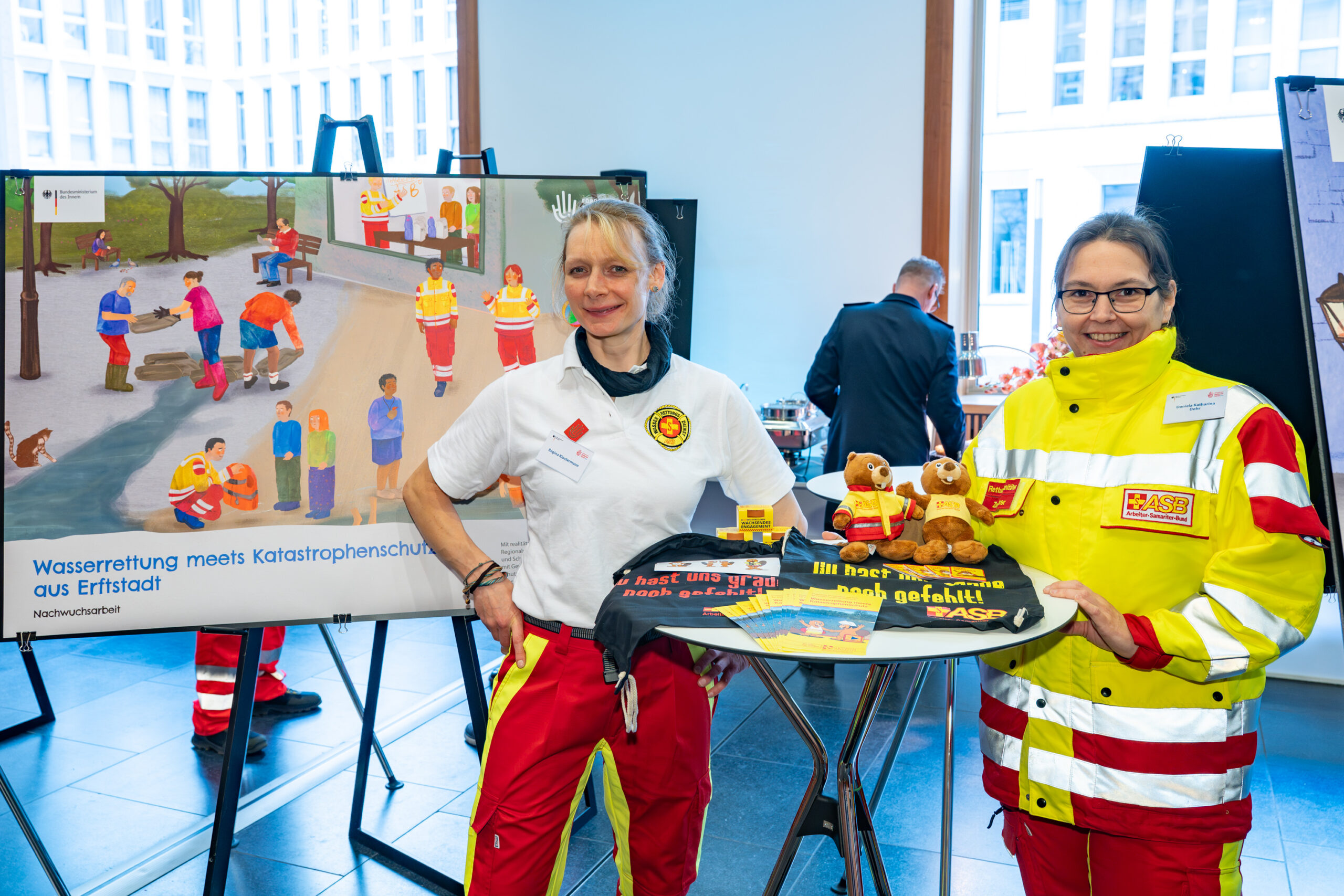
1st place in the category of youth development: Water rescue meets disaster control. (Source: Björn-Arne Eisermann)
Youth work
The ‘Youth Work’ category highlights how young people can be inspired to get involved in civil protection and how strong the link between everyday experiences and crisis management skills can be. First prize in this category goes to ‘Water Rescue Meets Disaster Control’ by ASB Rhein-Erft/Düren.
The starting point is a situation that many people are likely to be familiar with: more and more swimming pools are closing or reducing their services, and swimming lessons are being cancelled. At the same time, the number of people seeking refreshment in lakes and rivers in the summer is increasing. The discrepancy between the enjoyment of swimming and actual swimming ability is growing – with immediate consequences for the daily work of water rescue services. This is where the project comes in: pupils starting at the age of 5 spend a project day at a lake, learning in a practical way how to recognise dangers, deal with exhaustion or cramps and work together to rescue a person from the water. In addition, they learn first aid basics and what happens when a swimming accident turns into a major rescue operation.
Didactically interesting: The water rescue content is linked to modules on self-protection and disaster preparedness, as already offered by ASB on behalf of the BBK. This creates a mixture of water safety, first aid and crisis preparedness that can be implemented both on the water and – in a modified form – in the classroom. The project builds on experiences from the 2021 flood disaster and shows how educational processing and practical preparation can be intertwined.
The aim is not only to impart knowledge. The young people should experience self-efficacy, get to know their own possibilities and limitations, and learn that voluntary work is an exciting option: some former participants are now active in water rescue themselves and act as multipliers.
The other projects in this category also tell powerful stories of young people: ‘What if…???’ by the Niederkrüchten Youth Red Cross experiments with simulation games based on crisis scenarios, ‘Fire & Fin’ by the BRK community and Kissing Volunteer Fire Brigade combines youth fire brigade work with water rescue, ‘Young People in Emergency Services’ by Malteser Erftstadt gently prepares young volunteers for real-life emergencies, and in ‘Crisis Kids – Children Explain Disaster Control’ by the Neuss Youth Red Cross, children themselves become ambassadors for safety – with their own videos and podcasts.
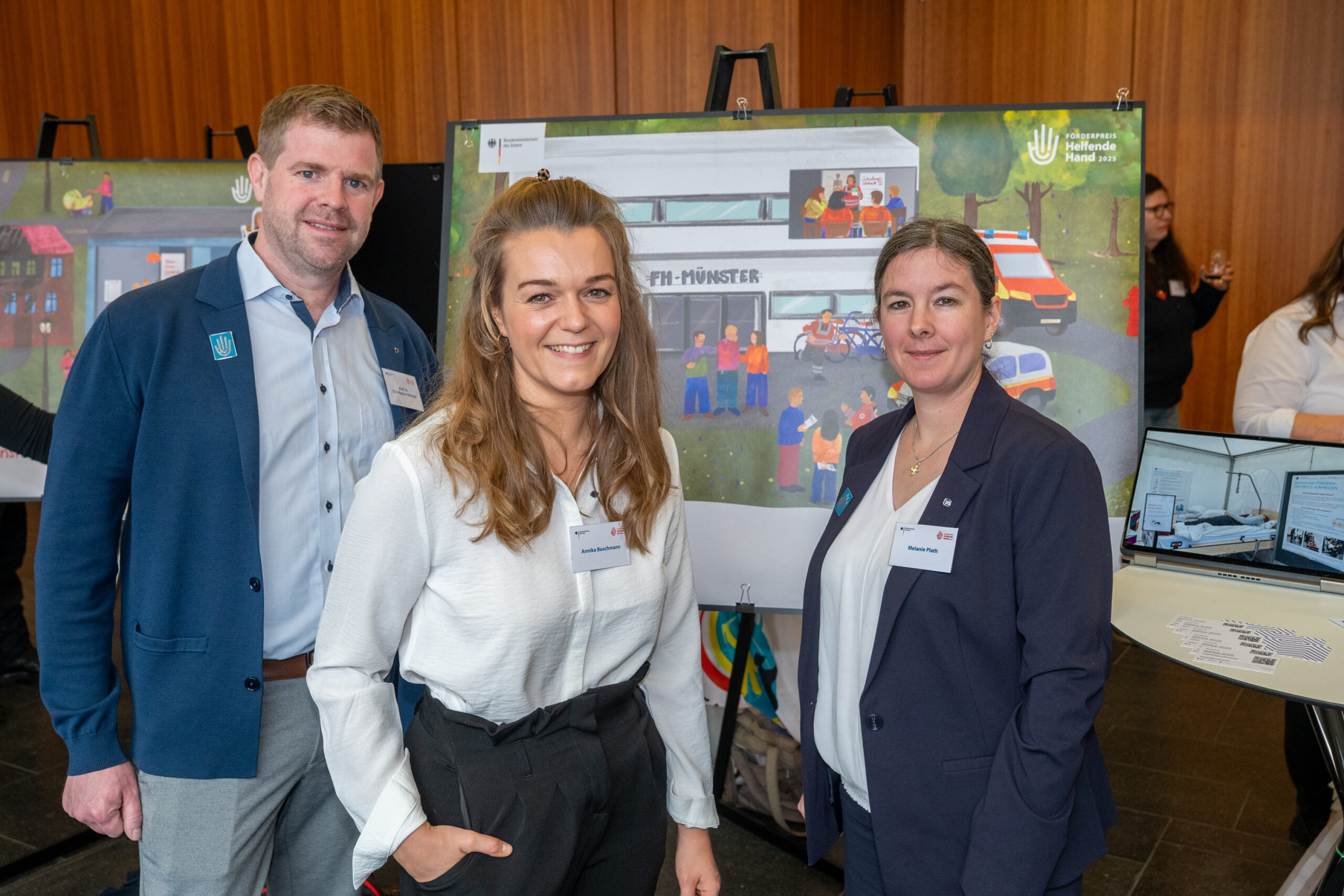
1st place in the category of support for volunteer work: Studi-PUK.
(Source: Björn-Arne Eisermann)
Support for voluntary work
The category ‘Support for voluntary work’ shows how strong partners can help civil protection. It recognises projects that improve the framework conditions – from technology and employers to academic training. First prize goes to the ‘Studi-PUK’ project run by the Münster University of Applied Sciences in collaboration with the Westphalia-Lippe regional association of the German Red Cross. ‘Studi-PUK’ stands for student nursing assistants. The idea is to provide students – particularly those in the health sector, but not exclusively – with specific training for civil protection tasks. In practical courses, they acquire skills that they can use in evacuations, emergency shelters or special situations. For the students, this is a low-threshold entry point into working with aid organisations. And for civil protection, it is a new, flexible target group that can be deployed for several days or weeks in the event of a crisis.
The project builds on experiences from the coronavirus pandemic, when many students spontaneously offered their help, from shopping for high-risk groups to working in testing centres. Studi-PUK takes this spontaneous willingness to help and turns it into a structured programme anchored in the university. Pilot projects have already been scientifically monitored, and the goal is to establish a permanent basic qualification in the degree programme, supplemented by annual training courses.
There is also a wide range of projects in this award category: ‘Electrical engineering -Support’ from ElektroTechnik Lüneburg GmbH shows how specialist companies can relieve the burden on voluntary structures. The Fire Protection-Center Münster Brinck is recognised as an employer that supports the fire brigade and other emergency services. The emergency radio concept developed by the DARC local association P49/FFW Laupheim establishes contact points in the event of communication failure, and the ‘Mayday Arena Hamburg’ of the TFA-TEAM Hamburg creates a unique training environment for breathing apparatus wearers.
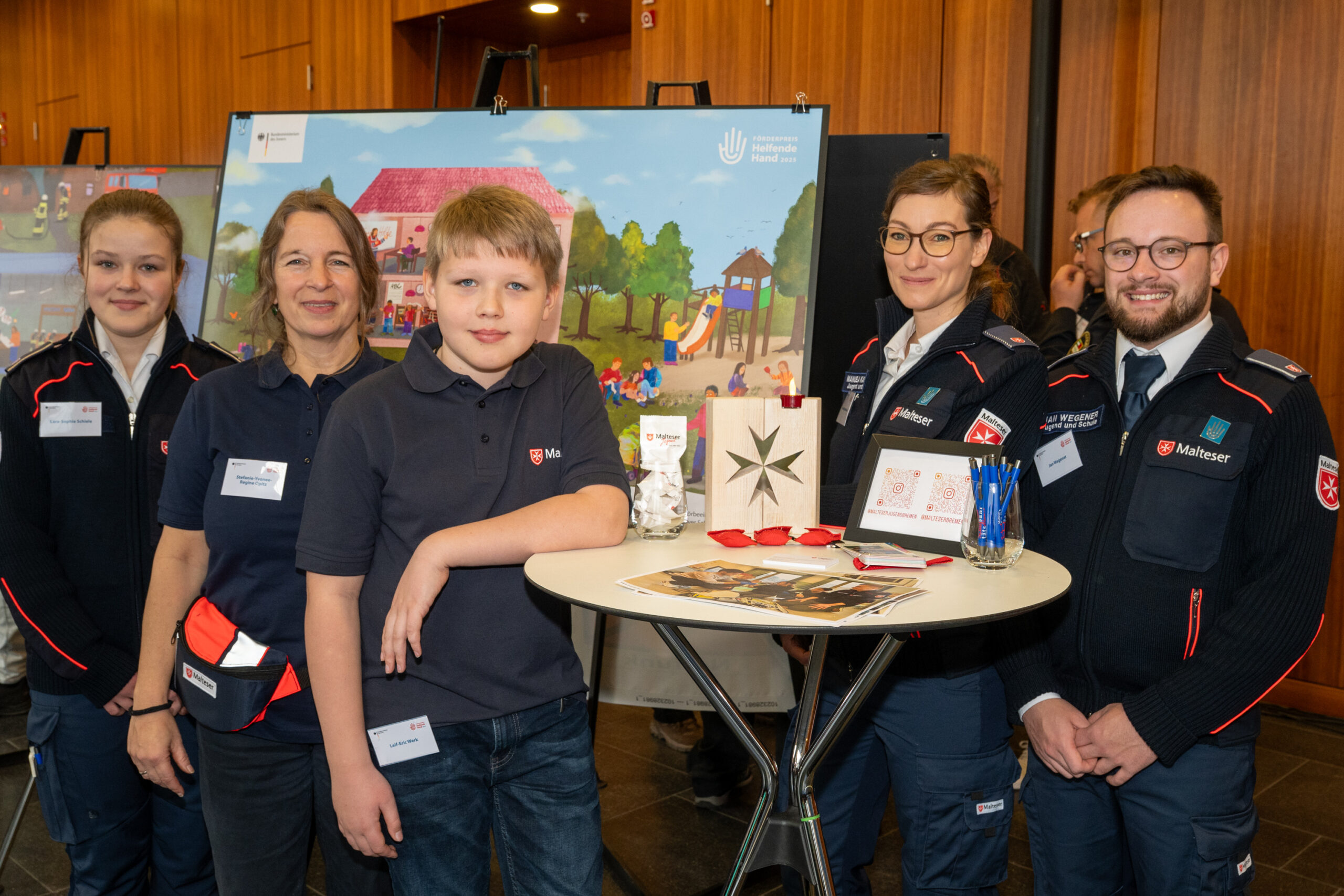
1st place in the Special Award for Inclusion category: First aid knows no barriers. (Source: Björn-Arne Eisermann)
Special Inclusion Award
A special highlight of the evening is the first-ever Special Award for Inclusion in Voluntary Civil Protection. It goes to the project ‘First Aid Knows No Barriers’ by the Malteser Youth Bremen. A school first aid service has been set up at a school in Bremen for hearing-impaired and deaf pupils, which has been designed to be barrier-free from the outset. Teaching materials are visually prepared, and sign language is a natural part of the programme. Practical exercises are designed so that work can be carried out safely even without acoustic signals. The aim is to enable young people to confidently administer first aid in everyday school life, while at the same time raising awareness of inclusion among the entire school community.
From a civil protection perspective, this is more than just an important school project: it shows that inclusion in voluntary work is not just a theoretical requirement, but is practically feasible if teaching methods, communication and structures are geared towards ensuring that everyone can really participate.
Interview from the podcast: ‘Hand and Heart – Your Voice for Volunteering’
Host: Katharina Bodmann
Interview guest: Jan Wegener, Head of Youth & School, Malteser Hilfsdienst Bremen
Question 1: How did the idea for the inclusive school first aid service come about?
Jan Wegener: The impetus actually came from the school itself: it wanted to set up first aid and a school first aid service. It quickly became clear to us that if we were going to do this, we wanted to make first aid accessible to everyone. So we looked at what the students specifically needed and how we could design the training so that no one would be excluded.
Question 2: What were the biggest hurdles and how did you overcome them?
Jan Wegener: The main issue at the beginning was communication. As trainers, we didn’t automatically know sign language. That’s why we worked much more visually and practically, without making the content ‘easier’ or shortening it. At the beginning, sign language interpreters provided support, but later we involved the teachers more closely so that the translation would fit well into the lessons. The key was to find a way forward together and remain open.
Question 3: How is the project changing the participants?
Jan Wegener: It’s a powerful feeling to not only receive help, but to be able to help others yourself. There is a lot of mutual learning during the training: we adapt methods and the participants show us what works well for them. At the end, many leave feeling noticeably more confident – because they can take responsibility and realise: I can act in an emergency.
Question 4: What does the award mean to you and what are your hopes for the future?
Jan Wegener: Above all, it is a thank you and a signal: inclusive civil protection is feasible if barriers are taken seriously and solved pragmatically. Our wish is that other schools, locations and organisations will follow suit. Barriers often seem insurmountable, especially when they are viewed as immutable.
The complete interview:
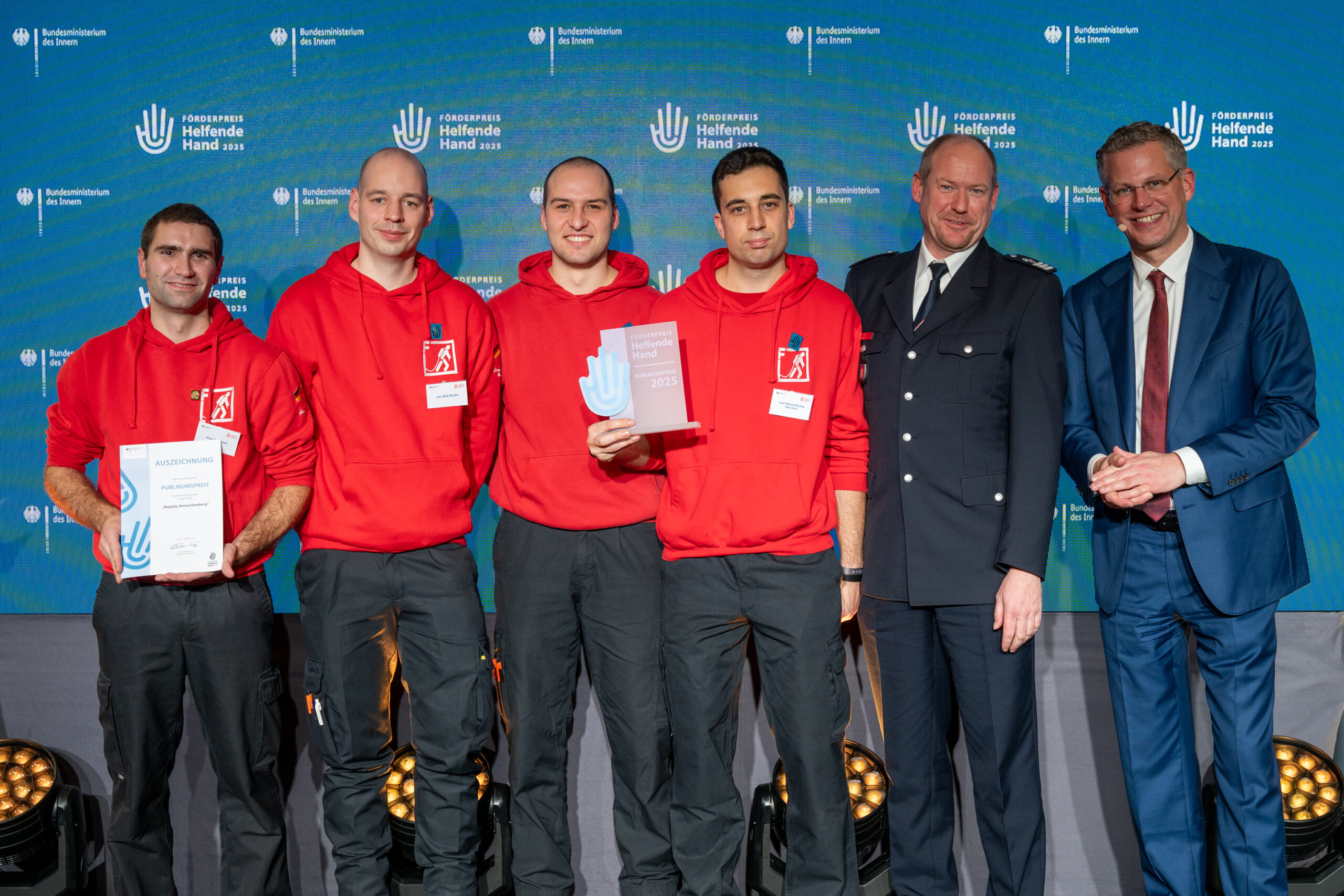
1st place in the Audience Award category: Mayday Arena Hamburg
(Source: Björn-Arne Eisermann)
Audience Award
Finally, the stage belongs to the audience: this year, 9,803 people voted online for the Audience Award, 2,525 of them voted for the ‘Mayday Arena Hamburg’ by TFA-TEAM Hamburg – a respiratory protection training course that is consistently designed on the basis of real accidents. Over a distance of 45 metres, breathing apparatus wearers experience scenarios based on serious breathing apparatus accidents in Germany and abroad. Each station refers to a specific incident in which something went wrong. This turns an ‘obstacle course’ into a learning space with a direct link to the reality of the job. The goal: to increase stress resilience, know your limits – and, in case of doubt, be able to save your own life. The fact that the course was set up on a voluntary basis and is already receiving enquiries from all over Germany shows how great the need is for such realistic training opportunities.
Remarkably, the Mayday Arena Hamburg not only won third prize in the category of support for voluntary work, but also the audience award. It is representative of many of the projects presented that evening, which reflect professional methods in voluntary work – from risk analysis and didactics to technical implementation.
From the podcast: ‘Hand and Heart – Your Voice for Volunteering’
Host: Katharina Bodmann
Interview guest: Finn Ole Block, TFA-TEAM Hamburg e.V.
Question 1: What is the Mayday Arena and why did you build it?
Finn Ole Block: The Mayday Arena is a modular respiratory protection training course covering around 45 metres. It is based on real respiratory protection accidents, including serious and fatal ones. It was important to us that it wasn’t just a ‘course’, but a training room that makes the reality of operations tangible. At the same time, it is also a memorial to colleagues who have died in accidents, with the clear goal of learning from accidents so that they do not happen again.
Question 2: How did you come up with the idea?
Finn Ole Block: In 2023, we were at the Academy as part of an exchange programme between the Hamburg Fire Brigade and Chicago, and we saw a similar track there. We were immediately convinced. Back in Hamburg, the idea quickly gained support from the academy management. Then, at the end of 2023/beginning of 2024, we started to implement it.
Question 3: What exactly is trained in the arena – technique or mental strength?
Finn Ole Block: Both. But the focus is strongly on mental fitness. The obstacles are extreme situations: narrow, confusing, physically demanding. Participants should learn to remain capable of acting even under stress, to control their breathing and to develop a good body awareness. There are different routes and the course is modular. We can exchange and further develop elements.
Question 4: What is the feedback from the training sessions like?
Finn Ole Block: Very positive – especially because many have never experienced anything like this before. In the first round, about 30 percent don’t complete the entire course, and that’s okay: the point is to recognise your own limits and make the right decision in an emergency. The debriefings are important. That’s where the learning effect often becomes really apparent.
The complete interview:
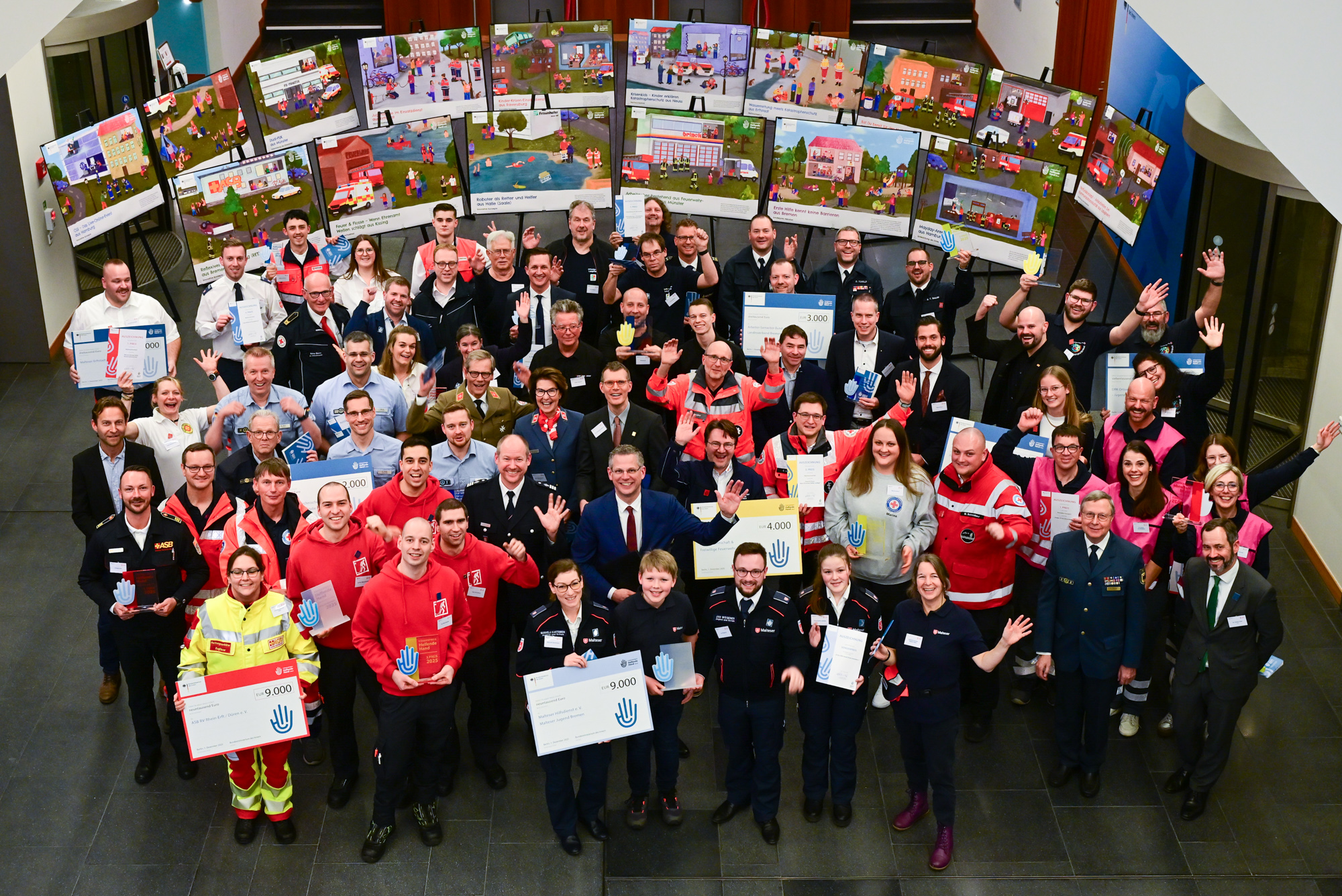
Joint conclusion of the 2025 award ceremony.
(Source: Björn-Arne Eisermann)
Wrap-up and outlook
When all the award winners come together for a group photo at the end, it becomes clear once again what has made the Helping Hand Award so special for over 15 years: it brings together people from a wide variety of backgrounds – from small local groups to universities. They all have one thing in common: they want to improve civil protection.
The BMI and BBK provide a framework for this commitment, raise its profile and support it both financially and ideologically. In addition, the award-winning projects receive support for their public relations work: each project receives an individual poster and a project film presenting its work and commitment. This ensures that the projects benefit from long-term visibility. Year after year, the Helping Hand tells stories that many people can relate to – as idea generators, trainers, local representatives or spontaneous supporters. And it encourages people to break new ground. With regard to the upcoming application round, the stage in the hall of the Federal Ministry of the Interior is open every year – for projects from all over the country that show what voluntary civil protection can achieve. The BMI and BBK will continue to work together to ensure that these ideas receive a helping hand – and the recognition they deserve.
Stay tuned: The application phase for the Helping Hand 2026 starts in March!
Take a look now, find out more, and join in!