12.12.2025 | Mission reports
Hot summers, dry forests and increasingly complex vegetation fires: forest fires have long since become a European challenge. When flames rage in southern Europe, it is not only local forces that are deployed, but also specialised teams from other EU countries. The NRW forest fire module GFFF-V DE1, the expert advisors from the aid organisation @fire and Johanniter-Unfall-Hilfe Bonn prove that international cooperation in disaster control is successful – supported by volunteers and backed by the Union Civil Protection Mechanism (UCPM).
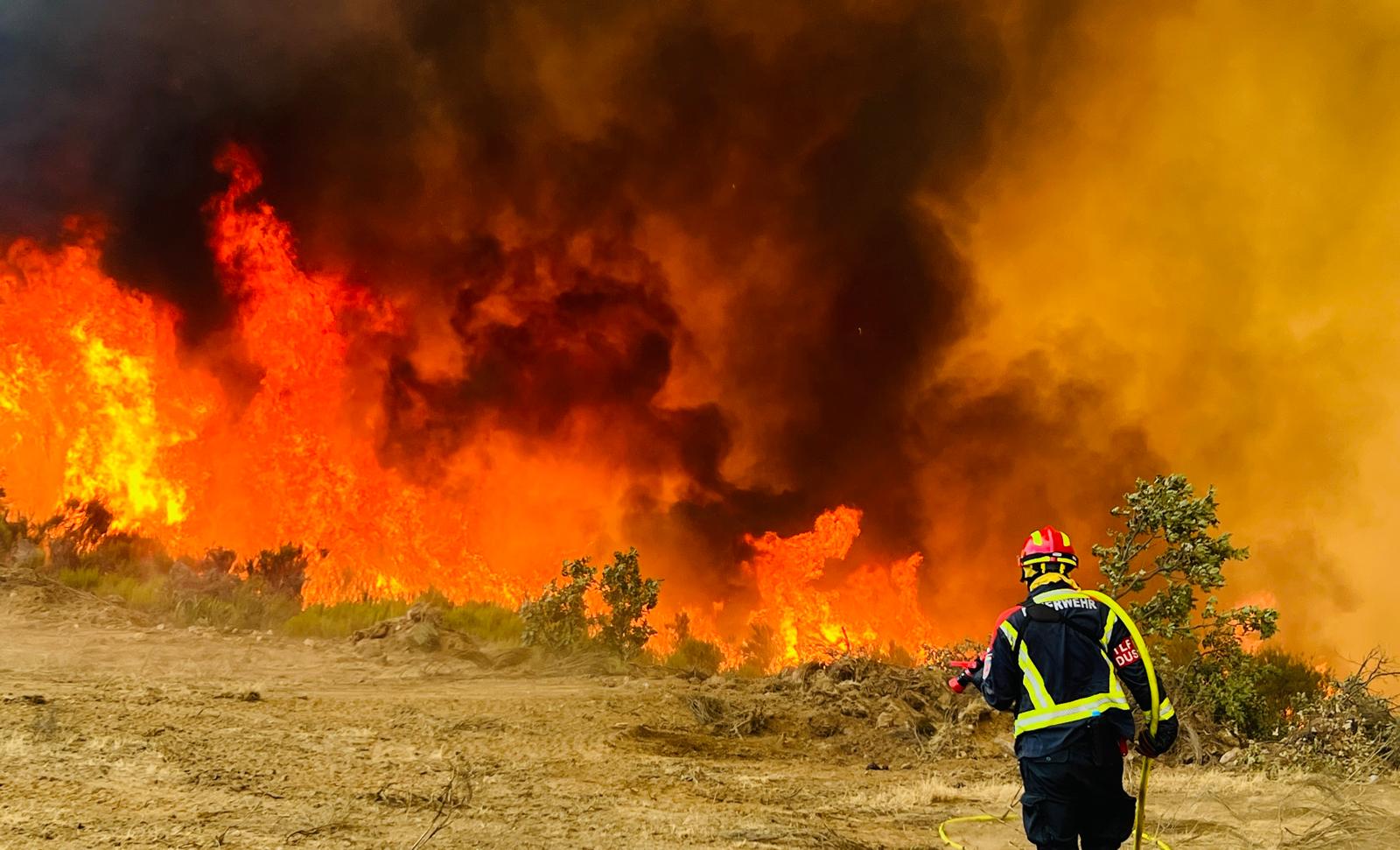
Firefighters battle high flames in Spain. (Source: Feuerwehr und Rettungsdienst Bonn)
European disaster management and civil protection in practice
The EU Civil Protection Mechanism provides the framework that makes cross-border operations possible. It defines standards, coordinates alerts and ensures that specialised teams in Europe can work together seamlessly. For many volunteers, this approach is not just an organisational structure, but a conviction that they live by every day.
Kai Lars Hildebrandt, head of a forestry office in Lower Saxony and volunteer with @fire, describes it as follows: ‘For our work at @fire, the European disaster and civil protection approach means one thing above all else: cross-border cooperation.’ For him, the fact that major disasters no longer have to be dealt with in isolation is crucial both professionally and personally: ‘It sends a strong signal that we as a European community are finding solutions together.’
The NRW forest fire module GFFF-V DE1 (Ground Forest Fire Fighting using Vehicles, Germany 1) is also a component of this system. It was developed in accordance with European standards and combines the expertise of firefighters from Bonn, Königswinter, Leverkusen, Ratingen and Düsseldorf with international training and clear tactical guidelines. Frank Frenser, who works in the field of leadership, operational planning and disaster control exercises at the Bonn Fire Department, explains: ‘The EU provides units to assist in a wide variety of disaster scenarios through the European Civil Protection Mechanism (UCPM).’ The module is not only a helper, but also a learner – a hub for exchange with experienced Mediterranean countries that have been dealing with intense forest fire seasons for decades.
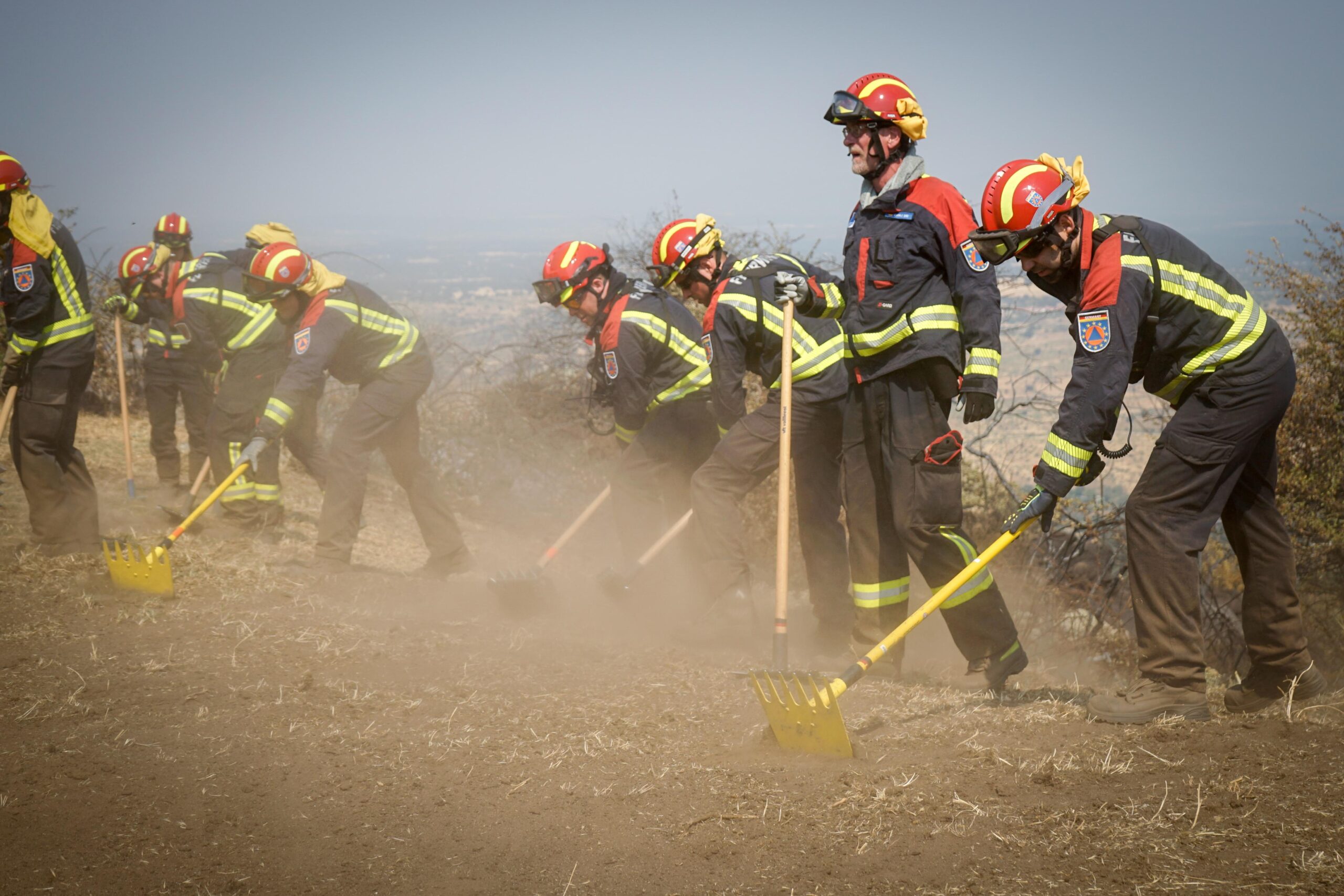
Full-time and volunteer firefighters are working together, applying their specialist knowledge to contain the spread of the fires. (Source: Feuerwehr und Rettungsdienst Bonn)
Preparation, specialist knowledge and well-coordinated cooperation
In order for emergency services in southern Europe to work efficiently, procedures, equipment and qualifications must be right. ‘The unit consists of around 20 emergency vehicles and around 70 emergency service members, who are provided by the fire departments in Bonn, Königswinter, Leverkusen, Ratingen and Düsseldorf and work either full-time or on a volunteer basis,’ says Frank Frenser, describing the structure of the module.
Preparation takes the form of joint basic training at the Federal Academy for Civil Protection and Civil Defence (BABZ), regular winter training phases and compulsory EU courses for managers. Only in this way can the module be seamlessly integrated into the structures of the requesting countries.
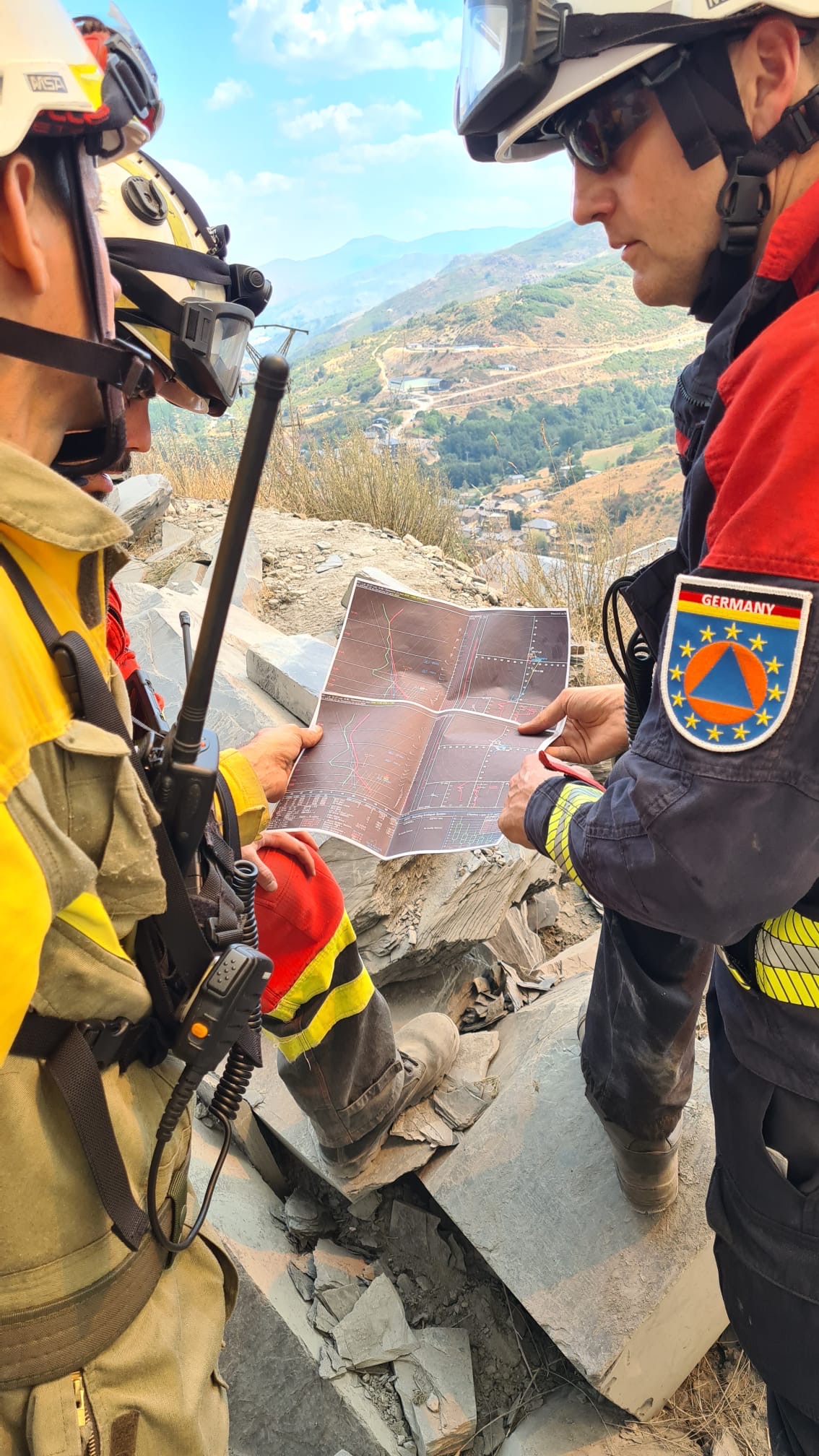
Various pieces of information are incorporated into the operational briefing with Spanish forces concerning the next steps. (Source: Feuerwehr und Rettungsdienst Bonn)
Yet a European deployment module is more than just a convoy of vehicles. In order to operate safely in unfamiliar vegetation, complex terrain and dynamic fire scenarios, expertise in vegetation, safety, topography and tactics is required – areas in which the aid organisation @fire complements the team. Kai Lars Hildebrandt describes the role this expertise plays: as a field safety officer in the Spanish operation, he not only supported safety in the camp and the operational area, but also ‘provided weather data, tactical recommendations and assessments of the spread of the fire’. As a trained forester, he was also able to contribute information on vegetation and soil. His knowledge of geographic information systems (GIS) enabled him to take over digital situation management: ‘I used CalTopo to keep the situation map up to date to ensure that the operations management had a precise overview at all times.’
The supply component provided by Johanniter-Unfall-Hilfe e. V. (JUH) is equally indispensable. Its contribution is crucial to ensuring that a European forest fire mission can be sustained over days and weeks. Verena Dienst, regional director and volunteer disaster relief worker for Johanniter in Bonn/Rhein-Sieg/Euskirchen, sums it up: ‘The Bonn branch of the JUH is responsible for the supply component within the GFFFV-DE1 module.’ The task is ‘logistical and humanitarian in nature, directly ensuring the operation and operational readiness of the firefighting forces.’ The Johanniter not only provide field kitchens, water supplies and storage, but also specialised training: hygiene and safety standards, mobile kitchen logistics, catering under field conditions and the ability to work independently – often in hot conditions, under time pressure and with changing deployment patterns. Every component, from packed lunches to the cold chain, is prepared according to proven standards and intensively trained before the season.
The fact that this interaction runs smoothly is the result of years of joint training. Frank Frenser emphasises: ‘The cooperation between the fire brigades involved and the other organisations has become well established in recent years.’ Regular exercises, joint equipment checks and coordinated command structures create the basis for ensuring that every move is perfectly timed at the scene of the emergency.
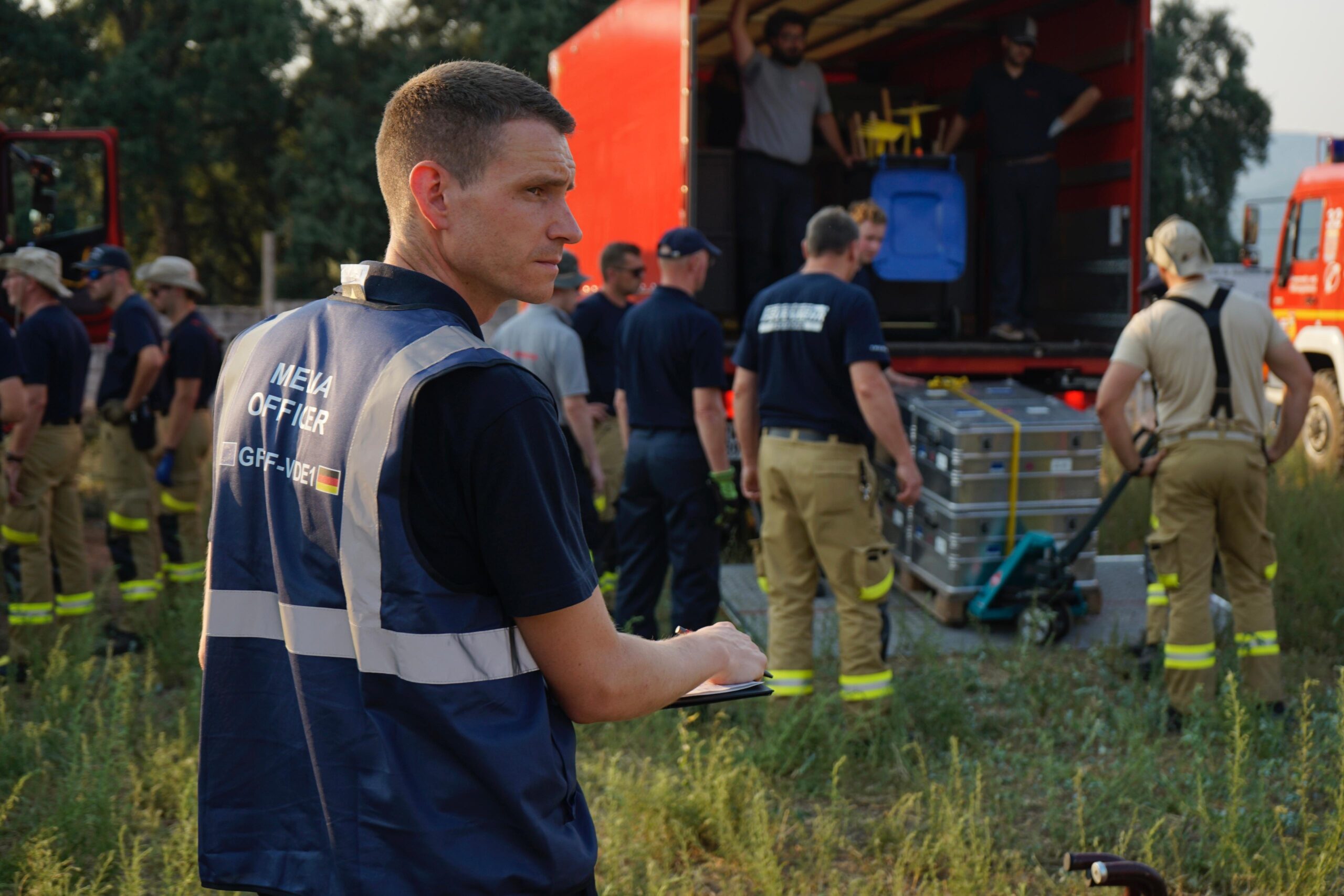
Frank Frenser emphasises the well-established cooperation and high motivation of the organisations. (Source: Feuerwehr und Rettungsdienst Bonn)
Spain 2025 – an operation amid heat, altitude and human proximity
The forest fire operation in Spain in the summer of 2025 demonstrated what European cooperation means in an emergency. For several days, German and Spanish forces fought together against rapidly advancing fires, changing winds and rough terrain. Frank Frenser emphasises that the operation was particularly influenced by ‘the impact of topography, wind, weather and vegetation type on fire behaviour’. At the same time, the Spanish forces contributed valuable local knowledge that the German teams were able to use directly in their work.
At the same time, @fire provided support with digital situation management and safety-related assessments. Kai Lars Hildebrandt describes how crucial this was for the incident command and sums up: ‘We were particularly impressed by the immense gratitude shown to us.’ And even at the supraregional level, it became clear how close-knit the networks have become. ‘Juan Camaño from the Pau Costa Foundation provided us with initial information about the situation while we were still on our way, as soon as he heard that we were on our way,’ says Kai Lars Hildebrandt. Moments like these illustrate how much expertise, personal contacts and mutual support shape the work of European civil protection.
The Johanniter also experienced both enormous challenges and touching moments. Operating their field kitchen independently for several days under difficult conditions required not only logistical skill, but also forward planning for cooling, supplies and hygiene. This made small gestures all the more meaningful – such as the moment described by Verena Dienst: ‘One of the most wonderful moments during the mission was when Elena, the head of the rural school camp in Sanabria, turned up with a basket of freshly harvested vegetables from her garden.’ For her, it was ‘a sign of gratitude and solidarity’.
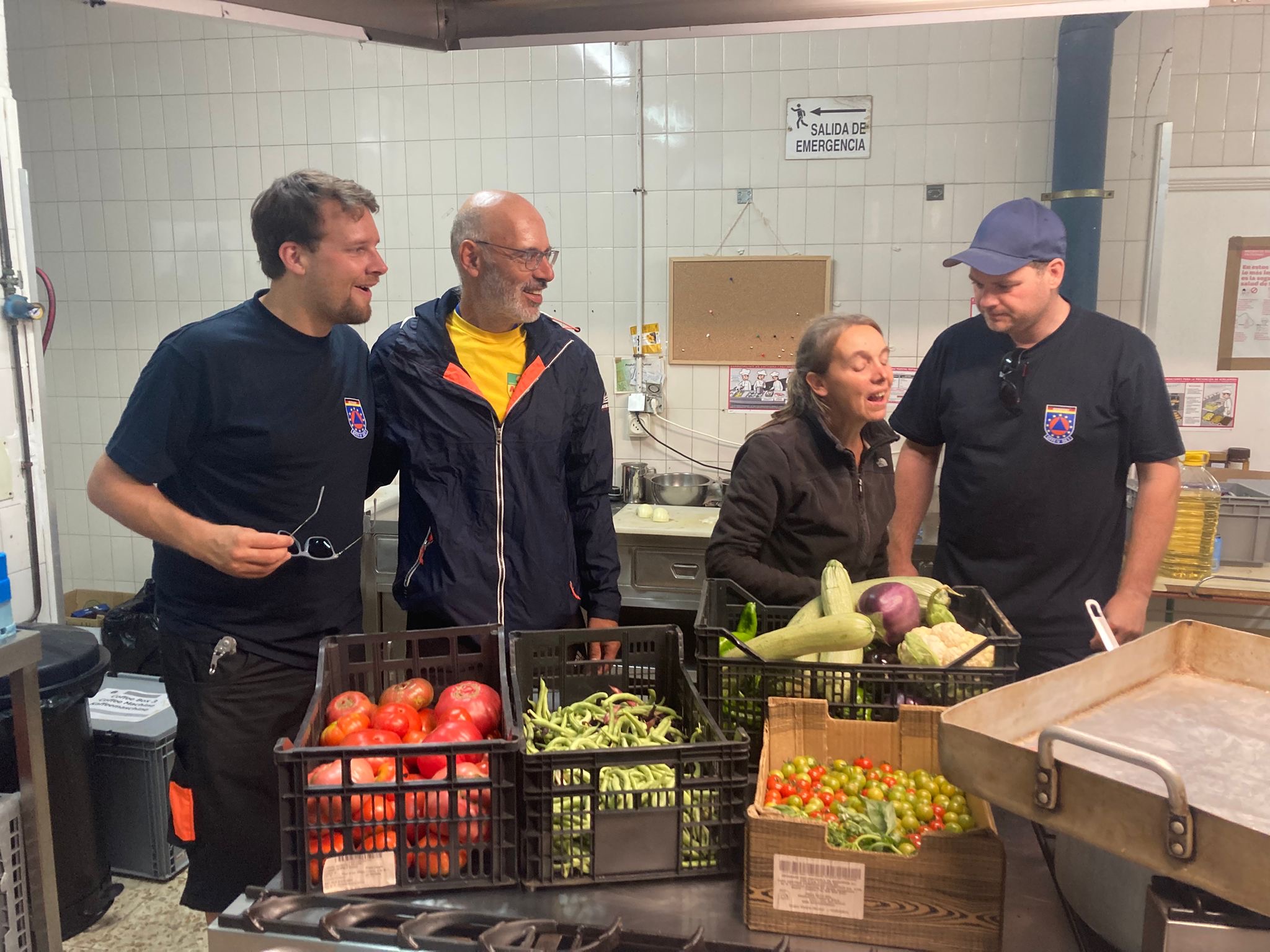
A token of gratitude: fresh vegetables from Elena’s garden. (Source: Feuerwehr und Rettungsdienst Bonn)
Volunteering as a foundation – commitment that goes a long way
As professional as a European response module may be, its foundation is built on volunteering. @fire is organised entirely by volunteers and, as Kai Lars Hildebrandt says, ‘thrives on the commitment of its members.’ Many want to not only deepen what they have learned in training, but also take advantage of the opportunity to gain experience in real-life operations and develop their professional skills.
In the forest fire module, too, a large proportion of the personnel are volunteers. Frank Frenser describes the motivation as follows: ‘From the opportunity to further one’s personal education, to contributing personal expertise, to the opportunity to live the European ideal directly, everything is included.’
Volunteering also plays a key role at Johanniter-Unfall-Hilfe – and requires a lot of support behind the scenes. Verena Dienst emphasises: ‘When it is decided within a few days or even hours that a two-week assignment abroad is about to begin, everything at home has to continue running smoothly.’ Without families, understanding employers and good preparation, this commitment would not be possible.
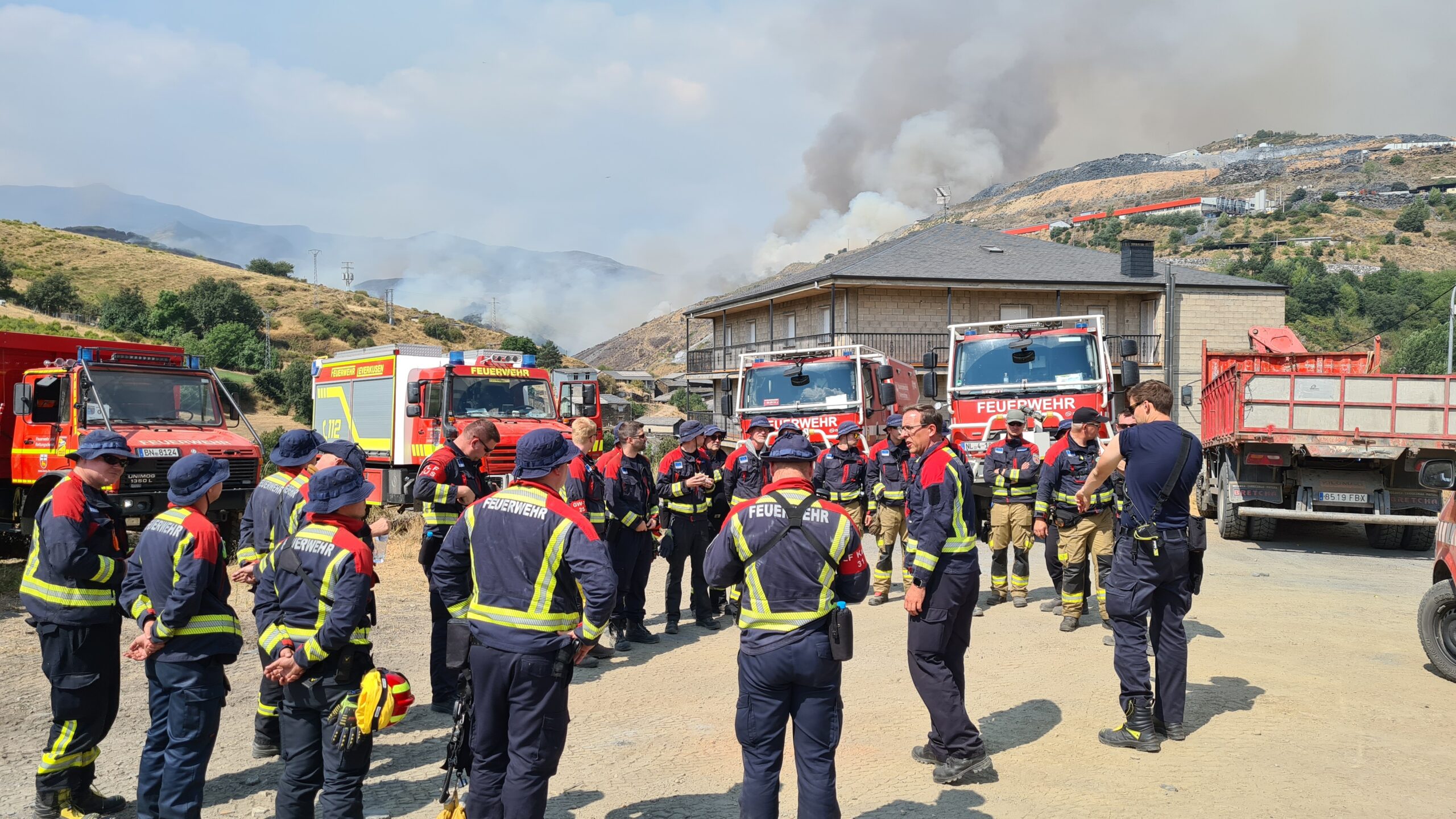
Unit deployment area. (Source: Feuerwehr und Rettungsdienst Bonn)
Learning, developing, strengthening together
The experiences from Spain are already being incorporated into new training courses, improved technology and more intensive European exchange formats. Kai Lars Hildebrandt would like to see ‘international exchange’ become more permanent and ‘common training standards’ expanded. He also refers to existing EU programmes such as the EU Academy and the ‘Exchange of Experts’ programme, which he believes should be further expanded in order to strengthen European knowledge transfer in the long term.
Further development is also a key focus for the forest fire module. Frank Frenser emphasises that progress is expected ‘especially in vehicle technology’ and that they are ‘eagerly awaiting the delivery of new special vehicles’ that will make work in the field even safer and more efficient. The Johanniter, on the other hand, are focusing on their internal structures: Verena Dienst emphasises how important ‘clear communication channels […] and structured material and supply planning’ are for future operations.
With each operation, not only does the knowledge of the individual organisations grow, but so does the European network, which can provide rapid and precise assistance in an emergency.
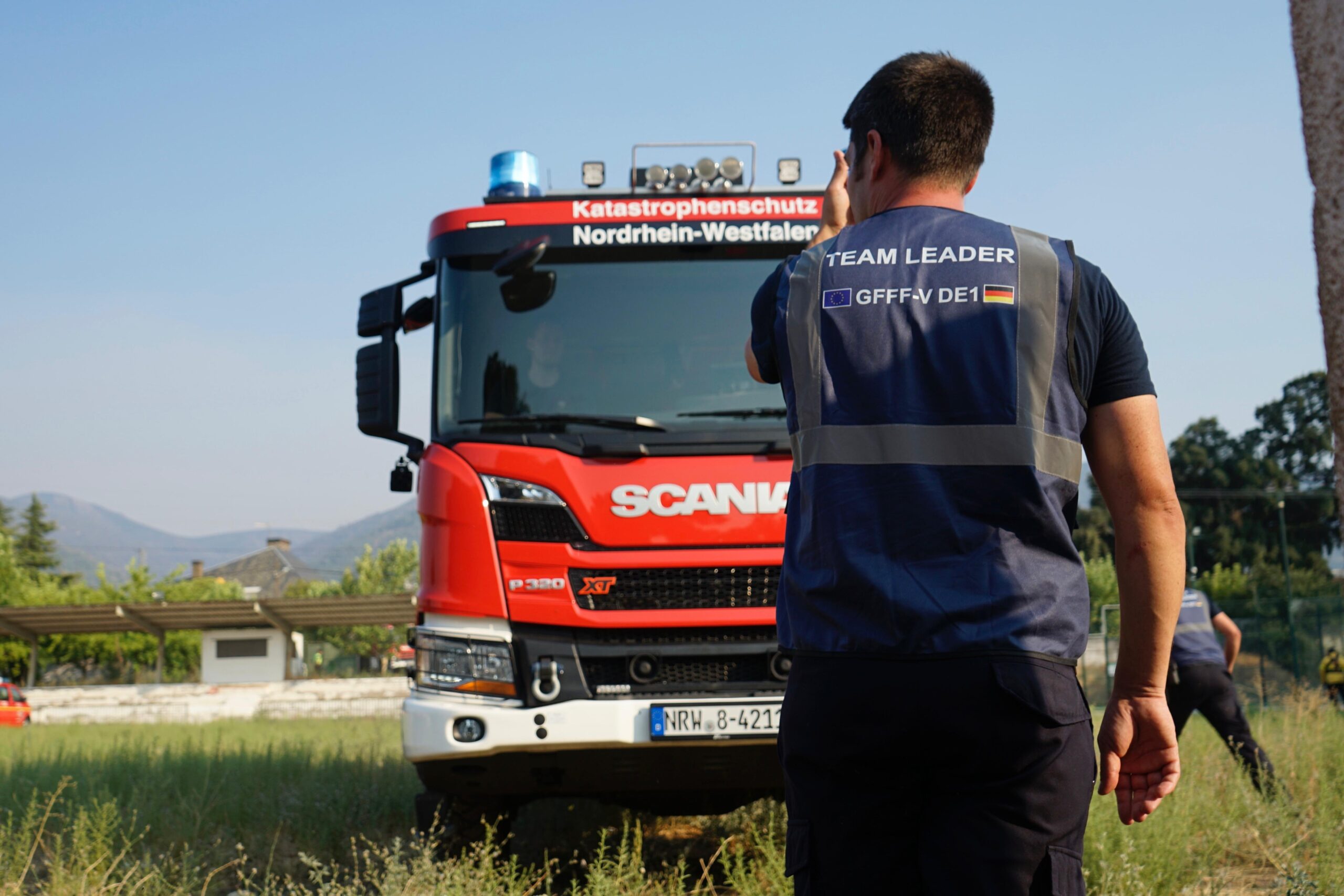
Future developments: Progress is expected particularly in the field of vehicle technology. (Source: Feuerwehr und Rettungsdienst Bonn)
The operation in Spain in 2025 became an impressive example of how modern disaster control in Europe can succeed: as a combination of professionalism, experience and humanity – and as a joint effort by many volunteers who are willing to take on responsibility across borders.
In view of the growing challenges posed by climate-related risks, this cross-border cooperation is more than just an organisational concept: it is an expression of a European promise. A promise that holds weight – because people fill it with life.