05.10.2026 | Mission reports, Report
In a real-life emergency, when destroyed river crossings bring traffic to a hold, every minute counts – as does the seamless coordination of many helpers. During the three-day large-scale “Brückenschlag 2026” exercise, participating local THW branches in Bavaria impressively demonstrated their skills. The exercise highlights just how indispensable volunteers are to civil protection. Even complex operational situations can be mastered when more than a dozen local branches work closely together.
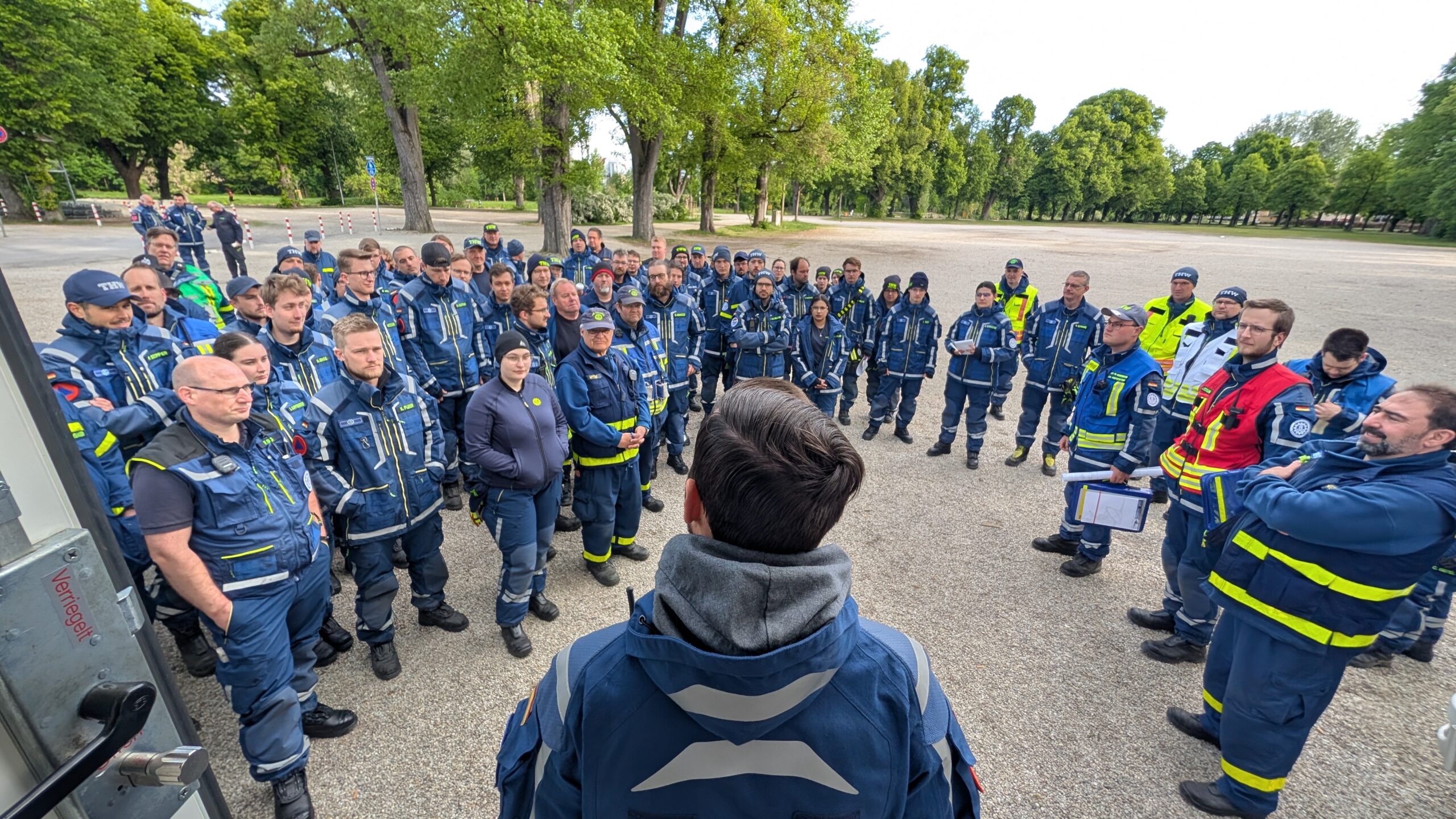
© THW, Matthias Simbürger – THW volunteers are being briefed ahead of the large-scale exercise “Brückenschlag”.
Around 120 volunteers from a total of 13 Bavarian local branches took part in the exercise. What the scenario looked like: the bridges in Landshut have been completely destroyed. Therefore, the focus of the large-scale exercise was on the construction of a fully operational 82-metre-long pontoon bridge across the River Isar. A pontoon bridge is a floating bridge that rests on hollow structures – known as pontoons – on the water. Thanks to natural buoyancy, the floating deck can carry even heavy emergency vehicles across rivers or lakes. It isprimarily used in disaster response when fixed bridges have been destroyed and a rapid connection needs to be established.
The floating bridge on the River Isar consisted of around 400 individual components, weighed approximately 30 tonnes and had a 28 tonnes load-bearing capacity. However, due to the limited point load, vehicles crossing the bridge were restricted to a maximum weight of 16 tonnes. The extraordinary dimensions and requirements made this an unusual project. “In my view, it was good that a floating bridge of this kind was built in Landshut again after 25 years. Given the current situation, it is entirely conceivable that it may become necessary to erect such floating bridges. This exercise has now enabled the necessary specialist knowledge to be passed on to the younger volunteers,” explains Sascha Hofstetter from the THW Landshut local branch (OV).
Massive logistics and precise work: Constructing a 30-tonne bridge
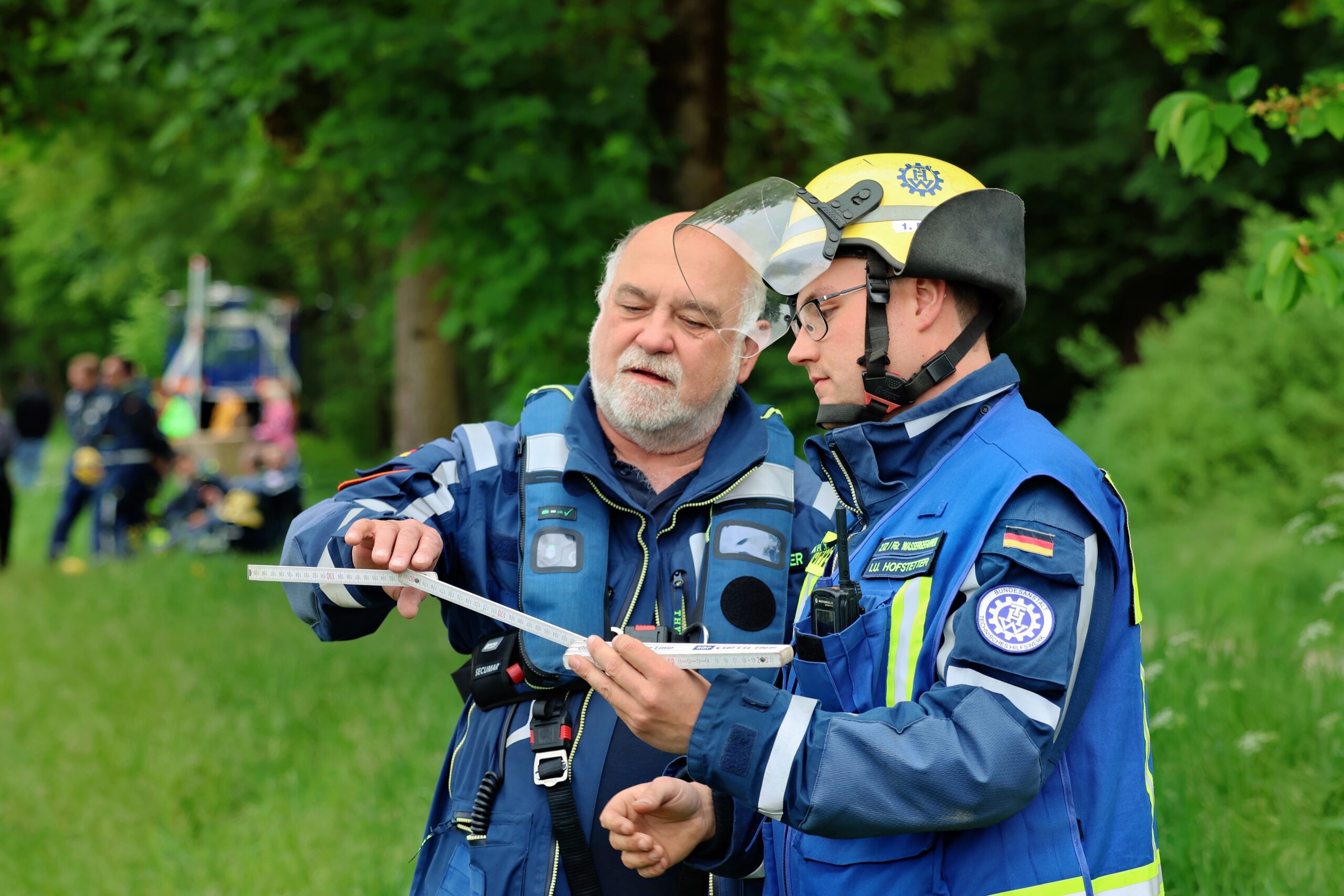
© THW, Matthias Simbürger – In civil protection, communication is particularly important: group leaders and exercise coordinators consult with one another.
Before a single component was placed in the water, a massive transport convoy rolled in. The required material was loaded onto a total of twelve trailers and roll-off containers. The components came from several THW local branches. To ensure a rapid response in an emergency, the floats (half-pontoons) and deck elements are always kept ready for immediate deployment on lorry trailers by the specialist bridge-building teams. No new materials had to be purchased for the exercise: the teams’ basic equipment and stored reserves were more than sufficient to build the entire bridge.
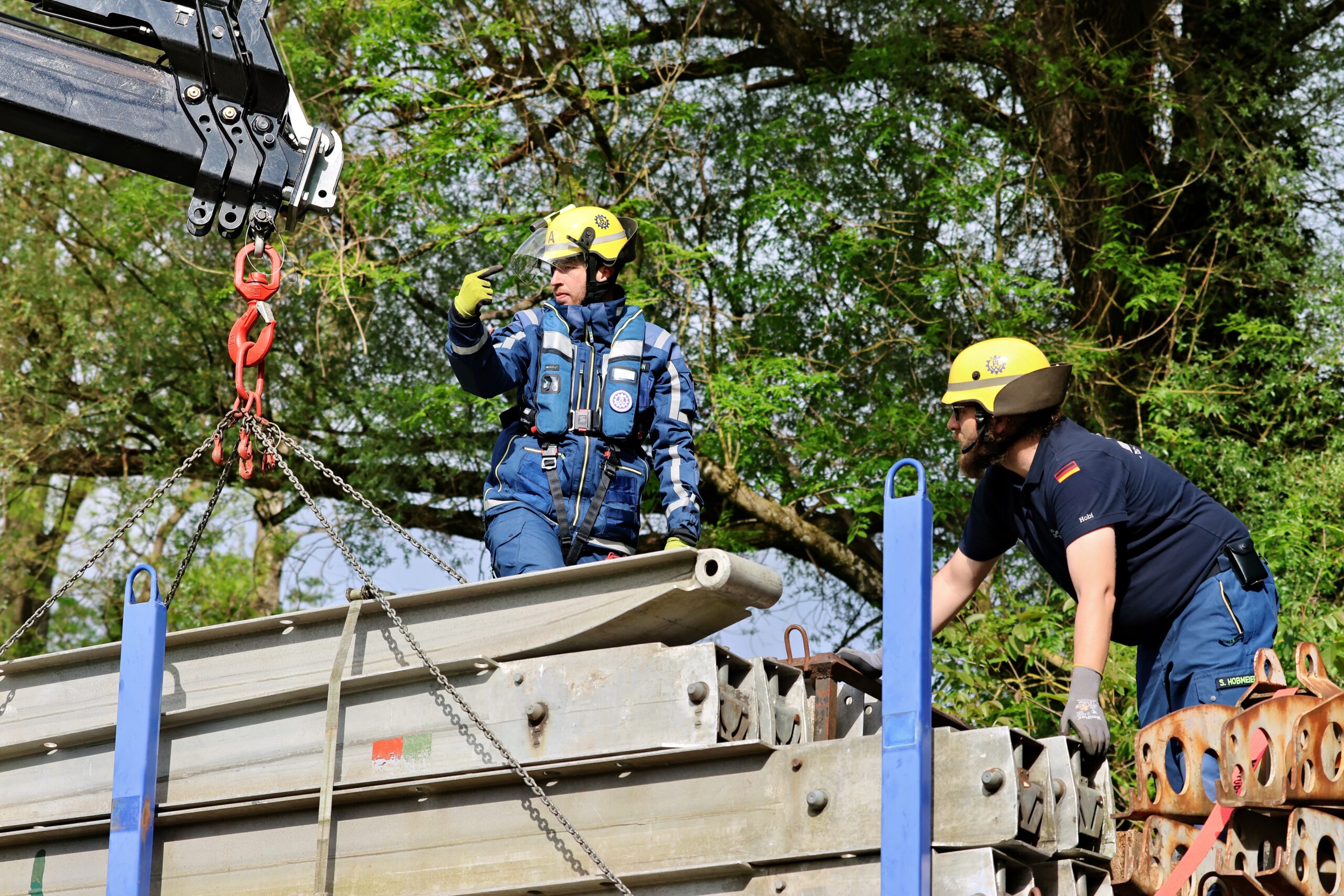
© THW, Matthias Simbürger – The main girders for the pontoon bridge are being unloaded by volunteers.
Work on erecting the pontoon bridge began early in the morning. Lukas Hofstetter from the Landshut local branch recalls: “It was stressful at first because there were some teething problems, but that’s to be expected with an exercise of this scale. Once the initial coordination difficulties had been overcome, the exercise went smoothly.” Right up until completion in the late afternoon, the volunteer emergency services worked hand in hand to install the individual bridge sections precisely and in the correct order.
Logistics was one of the biggest challenges. The materials had to be transported from the staging area to the assembly site at precisely the right time. “Space at the assembly site is very limited. It was not possible to set up a storage area there containing all the required materials. For this reason, the materials, which were loaded onto several lorry trailers, had to be delivered just in time,” explains Hofstetter. In addition to the actual transport, the coordination of the individual construction phases was crucial. This clearly demonstrated how important well-rehearsed procedures and an effective command structure are for success.
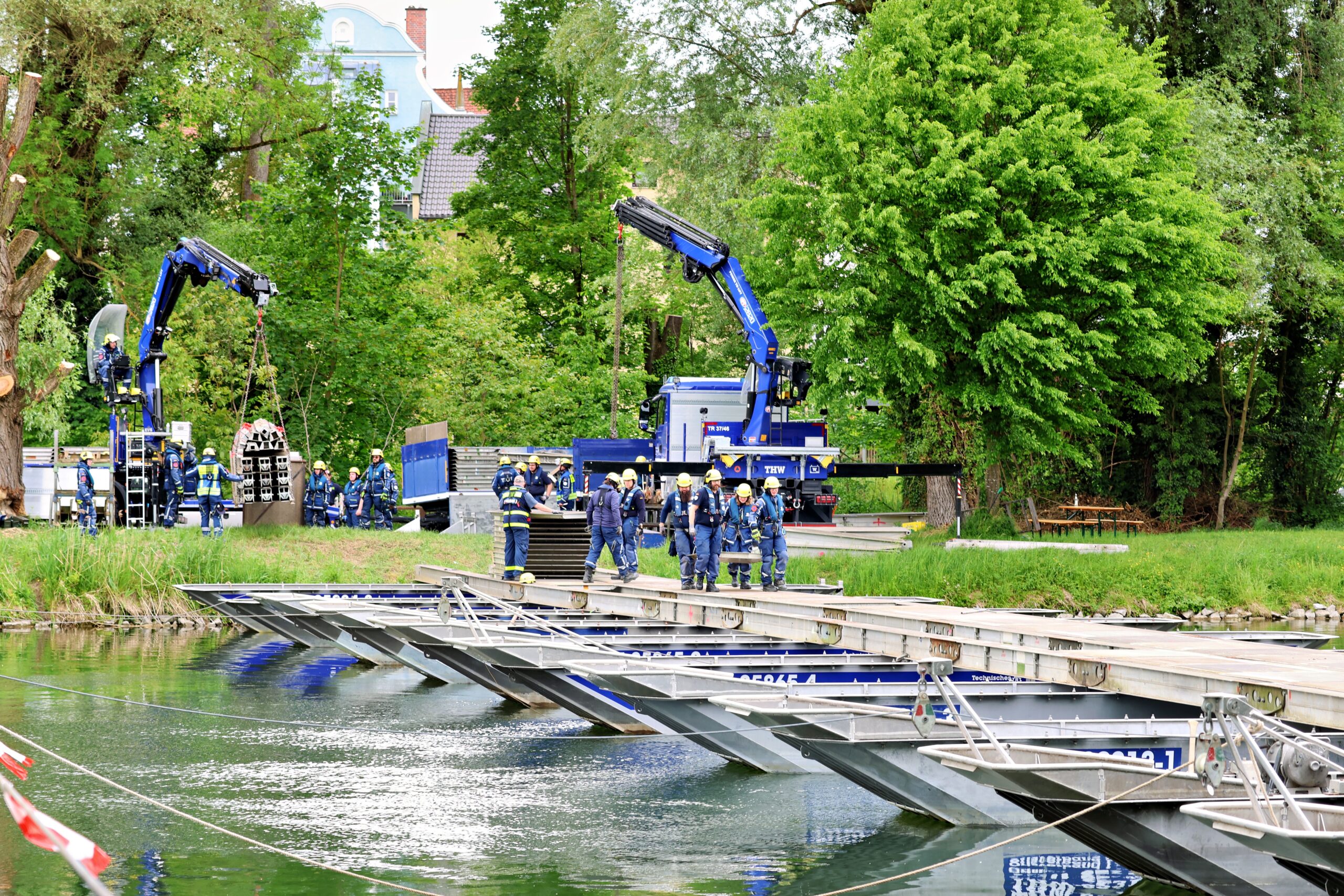
© THW, Matthias Simbürger – Volunteers from the various THW local branches work closely together.
Following the set-up on the first day, the second day of the large-scale exercise focused on getting the floating bridge to fully function. Emergency services from the regional office area took the opportunity to cross the Isar with their emergency vehicles via the temporary bridge, gaining valuable experience in handling this special infrastructure. After that, a pre-organised convoy of vehicles arrived. This included vehicles from the District Office, the German Life Saving Association (DLRG), the Malteser (MHD), the Bavarian Red Cross (BRK), the BRK Crisis Intervention Team (KIT) and the fire services, along with federal civil protection vehicles.
Key takeaways for future civil protection operations involving volunteers
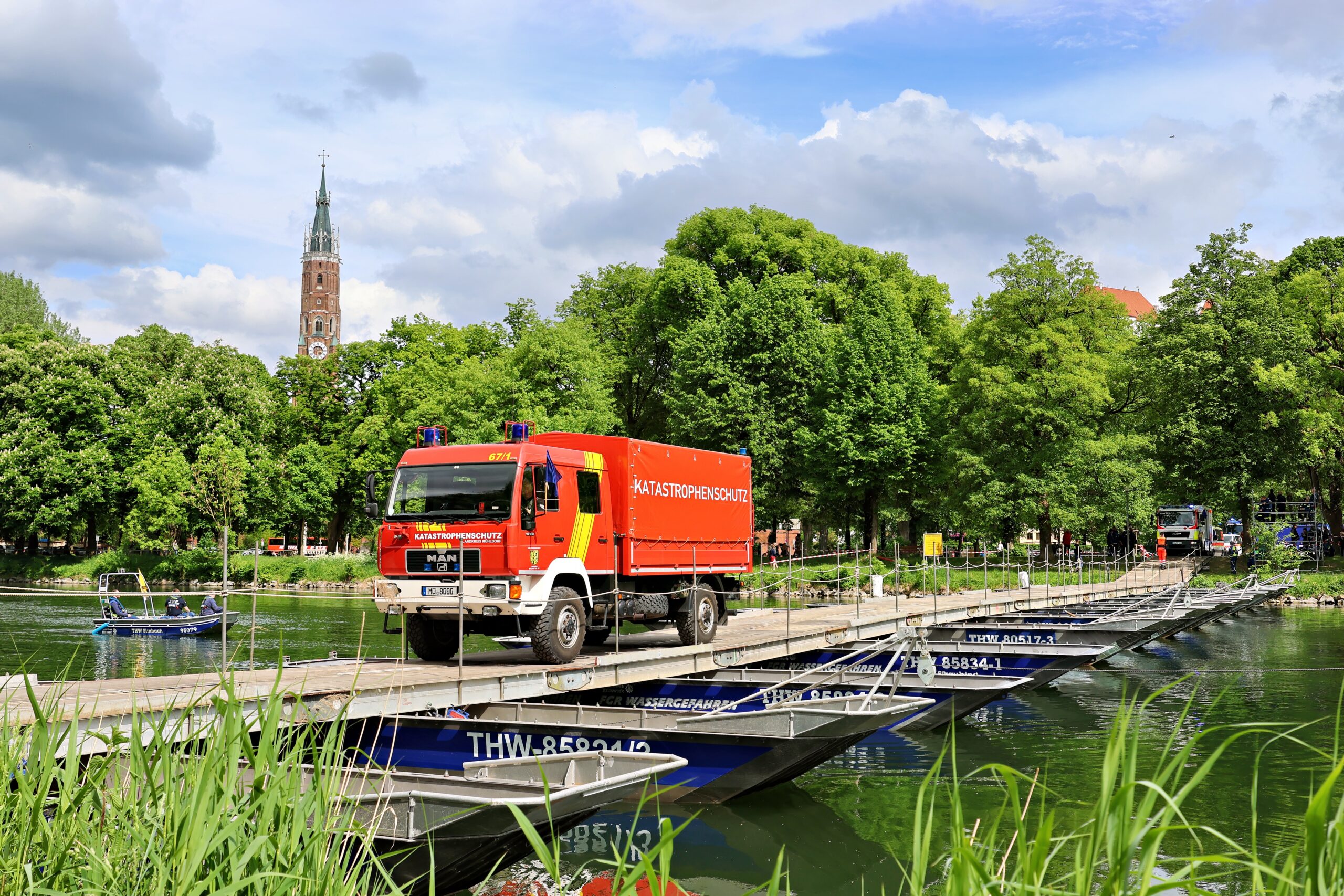
© THW, Matthias Simbürger – Heavy emergency vehicles are driving across the floating bridge.
Both the emergency services and the coordinators at the Mühldorf Regional Office gave an overwhelmingly positive assessment of the exercise. Above all, the seamless coordination between the teams was impressive: despite the Isar river separating the command post, staging area and construction site, coordination via radio worked exceptionally well. The Command and Communications Unit managed the precise movement of materials, ensuring that the components arrived on time at the construction site and that the 82-metre-long floating bridge could be completed as planned.
The practical exercise went smoothly. The subsequent test runs involving an entire convoy of vehicles from various aid organisations demonstrated the resilience of the infrastructure. At the same time, the exercise offered emergency responders a valuable opportunity to practise their own skills under real-life conditions and to extend their knowledge. “By regularly carrying out large-scale exercises like this, you internalise procedures, improve cooperation and can act quickly and effectively in an emergency. This has enabled us, as the local branch, to improve our internal processes for future operations and exercises,” says Jonas Esslinger from the Landshut local branch.
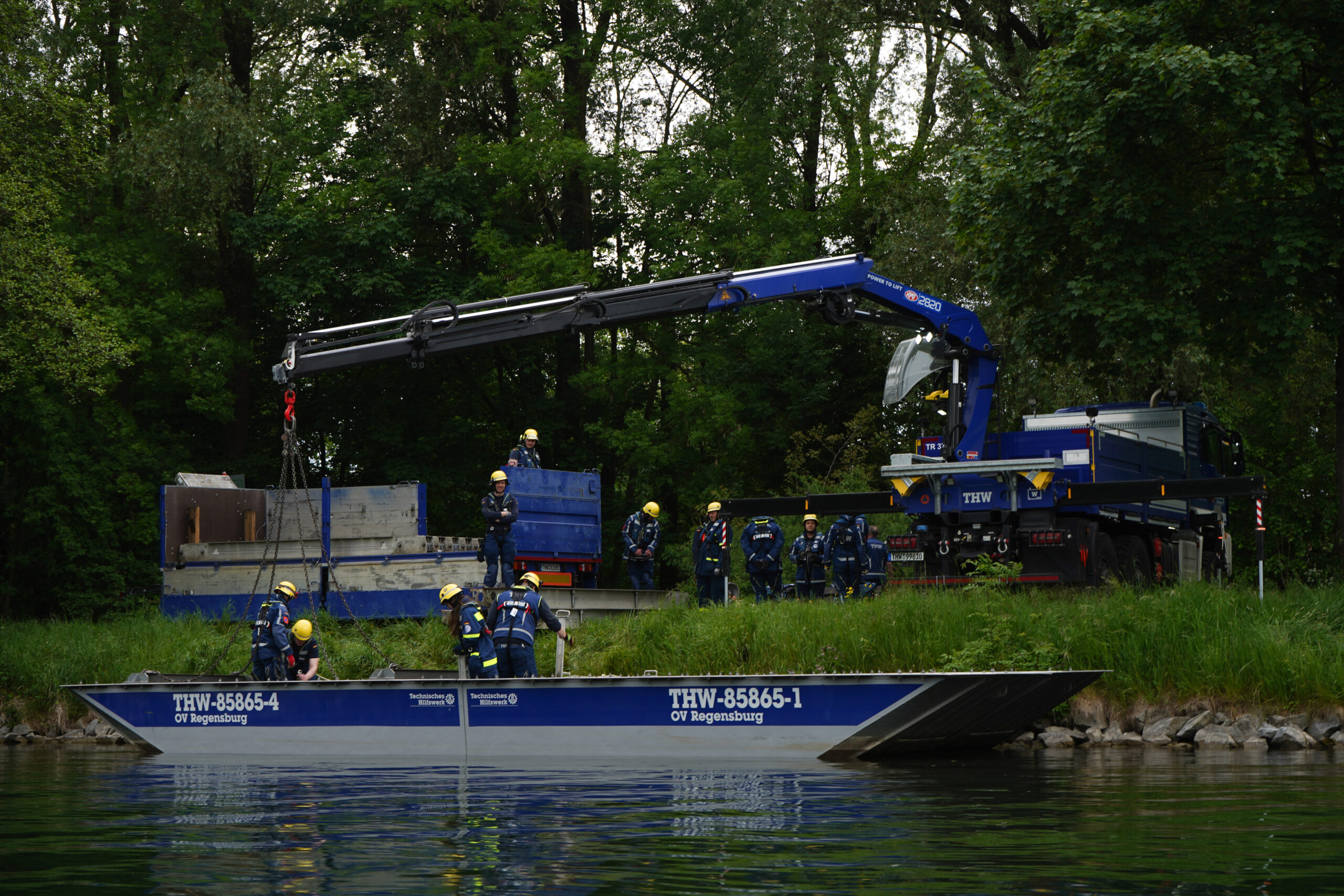
© THW, Matthias Simbürger – Volunteers from the various THW local branches work closely together.
The exercise served to build bridges between the local volunteer branches, providing an opportunity not only for in-depth professional exchange but also to get to know the people in uniform better. “Once again, we saw just how closely the ‘THW family’ sticks together and works as a team,” said Esslinger. Alongside successful logistics and safe driving operations, the camaraderie and interaction contributed significantly to the positive overall outcome.
The insights gained are now to be incorporated into future staff meetings and regional office training courses. This strongly indicates that the THW is ready and prepared for any situation – and that voluntary work in civil protection is sustainable.
This article by Sebastian Freudling and Sascha Hofstetter was originally published in the THW Journal BY, Volume 47, 02/2026.